

Going A-Sitting: The 200-Year-Old Knitting Circles That Came With Their Own Songs
The rotating knitting nights that turned an evening chore into the social life of an entire community.

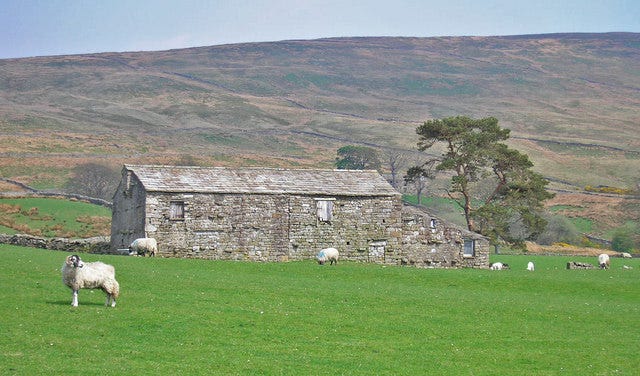
William Howitt, touring the Yorkshire dales in the 1830s for his book The Rural Life of England, gave the local custom its proper name: a Sitting, or going-a-sitting. As soon as it got dark and the day’s work was done, the young children were put to bed, the fire raked out or banked down, and whoever was left wrapped a cloak round themselves, lit a lantern, and set out with their knitting for whichever neighbour’s house it was that night. It was, he wrote, “a regularly circulating assembly from house to house through the particular neighbourhood,” and the whole troop of them would sit and knit, sing knitting-songs, and tell knitting-stories, sometimes past midnight, rocking to and fro, as Howitt put it, “like so many weird wizards.”
The songs weren’t only to pass the time, but they were actually work songs. One he transcribes counts a flock of sheep down and back up again:
“Bell-wether o’ Barking, cries baa, baa,
How many sheep have we lost to-day?
Nineteen have we lost, one have we won,
Run Rockie, run, run, run,”
the number falling by one each round of the stocking until it hits zero, then climbing again as the next round starts. The verse tracked the stitch count, so finishing the song and finishing the round supposedly happened together.
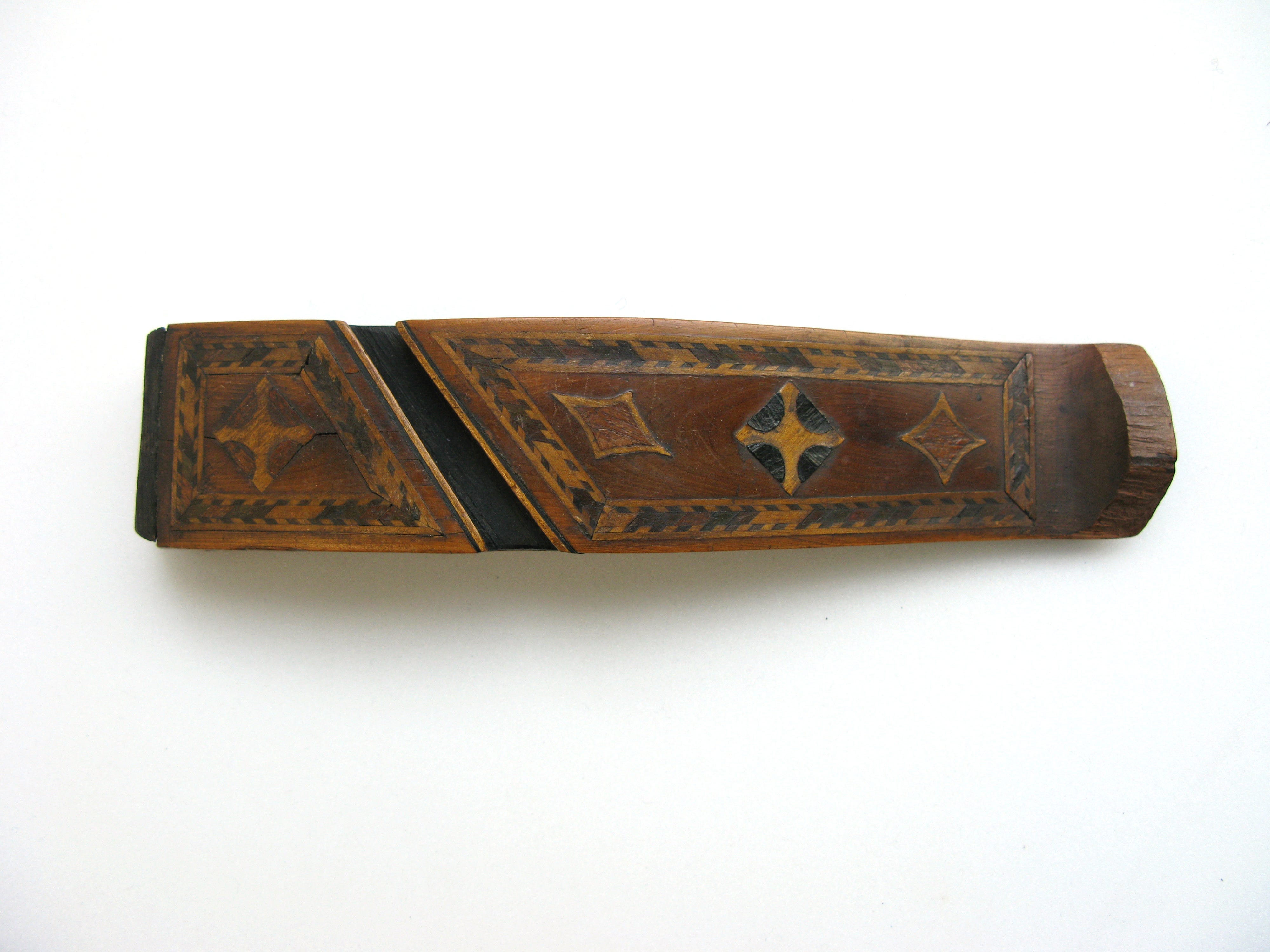
Everyone knitted with a knitting-sheath, a curved hollow piece of wood worn tucked into a belt called a cowband, often carved and given as a love token, with a clew-hook on the band so the yarn didn’t dangle. On this rested a real regional trade: a pair of stockings, or a coarse worsted cap knitted for the local market, apparently a full day’s work that sold for three pence. Howitt met a farmer’s daughter reckoned the best knitter in Dent, who could make four of these caps in a day, a shilling’s worth of work for a fortune’s worth of reputation. In the next dale over, Garsdale, the men knitted with such concentration round the fire that they pinned cloths to their shins to keep from scorching them, and would sit outside afterwards to cool off, still wearing the shin-cloths, “making,” Howitt says, “the oddest appearance imaginable.”
William wasn’t the only Howitt writing about this stretch of Yorkshire. His wife Mary set her 1840 novel Hope On, Hope Ever in this same Dentdale, and drew the custom just as plainly: “Old men and young, women and children, all knit. The aged man, blind and decrepit, sits on the stone seat at the door, mechanically pursuing that employment which seems as natural to his hands as breathing is to his lungs.” The old woman of the house knits while rocking a cradle with her foot; the generations in between pick their knitting up and lay it down as the day allows. Nobody in the story finds any of this remarkable. For all anyone there knows, Mary Howitt writes, “the rest of England knit as much as they.”
She also has them already looking back on better days: “though everyone says the trade was better in their father’s time, they still go on knitting, contented in the belief that... the dalespeople will always be knitters.” That’s 1840, seven years before an old man wrote to the Leeds Intelligencer to say much the same thing about his own youth in Wensleydale, a little further north. Every generation in this story seems to have inherited the conviction that the one before it had it better. Some of that is probably just what people in a trade like this always say about the generation before them. But some of it wasn’t imagination: this was exactly the period when framework knitting machines and factory-made hosiery were undercutting hand knitters’ piece rates across England, a real structural squeeze running underneath whatever each generation happened to remember. Both things, it turns out, can be true at once. The trade really was being hollowed out by machinery, and every old man in it still had a tendency to round his own youth up.
The same letter names a specific man, John Coates, whose sole employment was knitting and whose other pursuit was hunting, and describes him knitting while following the hounds at a moderate pace, clearing a hedge or a wall without dropping a stitch. I can’t verify it, and vivid details like this are exactly what fond memory produces whether or not they happened quite that way, but it doesn’t need to be literal to make the point: knitting fit into whatever else was going on, hunting included.
Dent and the surrounding dales like it had a national reputation as knitting country, and they weren’t the only region with one. Wales’s hill country was another. An 1850 account of a Merionethshire hill farm describes the same winter-evening pattern under a different name: family and servants gathered together after supper in the “ingle-nook,” lit by a homemade rushlight that burned barely half an hour before it needed tending, and whilst so assembled they prepared more candles, spun, knitted, sewed, or cut wooden spoons, before the Bible was read aloud and the household went to bed around nine. Different region, different craft list, the same shape: a fixed evening gathering round a single weak light, knitting one of several things everyone’s hands were doing at once.
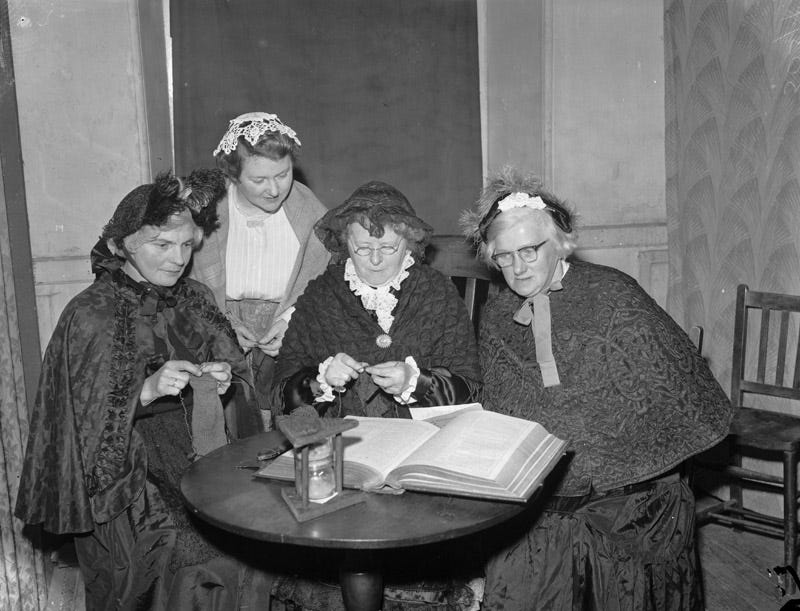
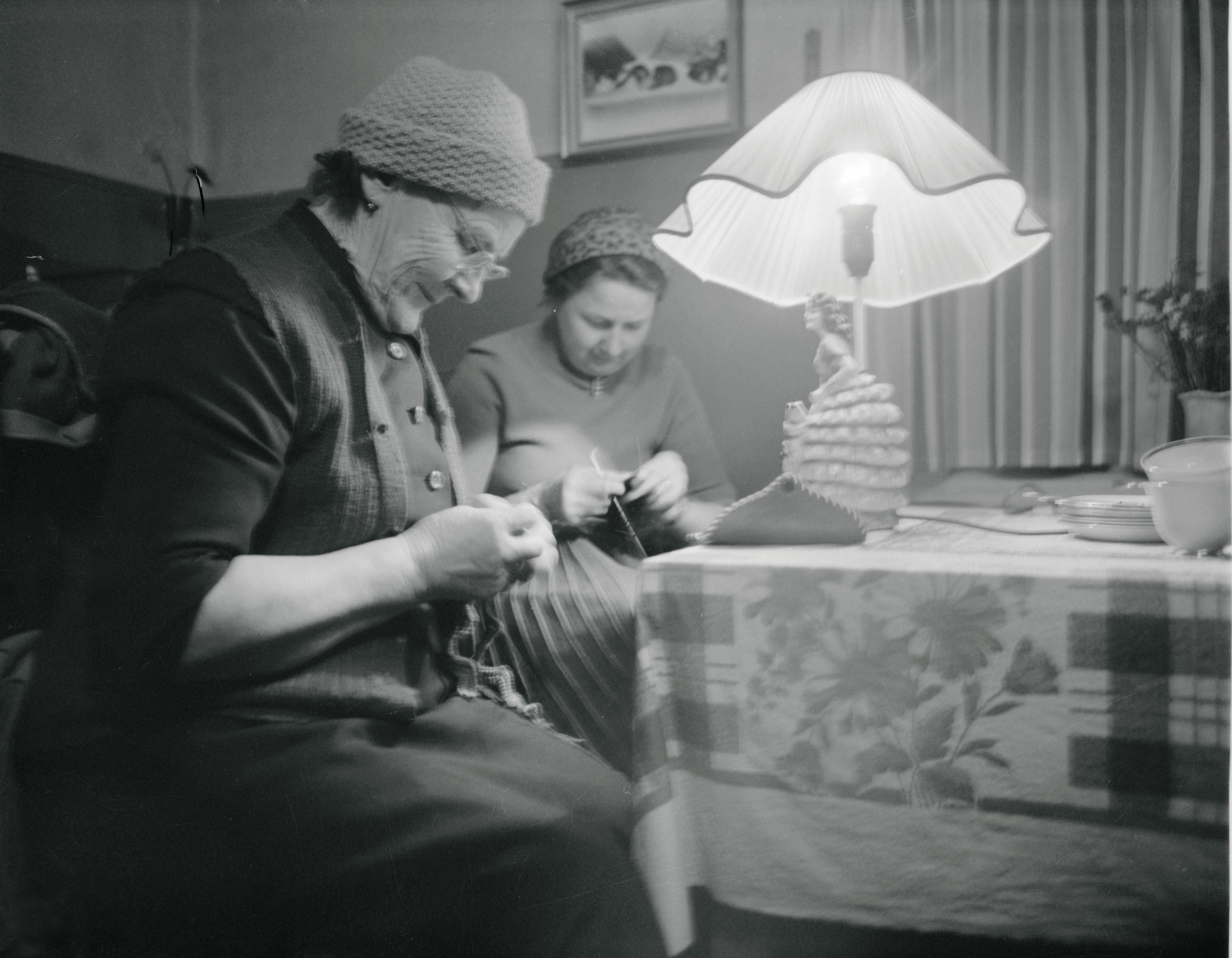
Knitters still do the same today, we’ve just given it a different name. A knitting club, knit and natter, craft night, whatever you like to call it, is a sitting without the singing, the same excuse to sit with your hands busy and other people nearby, the knitting and the company propping each other up so neither one has to be the reason you’re there.
Howitt had a plain enough word for what the original version was actually for, and it undersells nothing by being so plain: a social assembly of the neighbourhood, “not for eating and drinking, but merely for society.” The songs, the sheaths, the industry, the reputation for speed, all of it ran on top of that one fact, and it’s the same fact still running underneath a knit night meeting in the back of a yarn shop tonight.
Further reading
William Howitt, The Rural Life of England, vol. 1 (1838), "Of Lancashire and Yorkshire," pp. 306–313: Description of “going-a-sitting”.
Mary Howitt, Hope On, Hope Ever (1840), as quoted in Harwood Brierley, “A Little of Mary Howitt,” The Newcastle Weekly Courant, 26 February 1898, p. 2: A novel set in Dentdale.
“Wensleydale Spinning and Knitting,” letter to the editor, The Leeds Intelligencer and Yorkshire General Advertiser, 13 November 1847, p. 3: An old man’s account of his own youth in the Wensleydale.
"Life in a Merionethshire Hill Farm," quoting Cliffe's Book of North Wales, Liverpool Mercury, 10 May 1850, p. 2: A similar evening-gathering on a Welsh hill farm.
I really enjoyed reading this, thanks Jonathan!
The photo of the Welsh ladies knitting is fab. Tanygrisiau, the place name, literally means 'under the stairs!'
This is wonderful. I loved all the detail. I've been to Dent but the museum was closed when we were there - I definitely need to go back again some time.