

A Second Craft
A hand-knitter gets a machine, discovers a second craft, and can’t stop thinking about the Luddites.

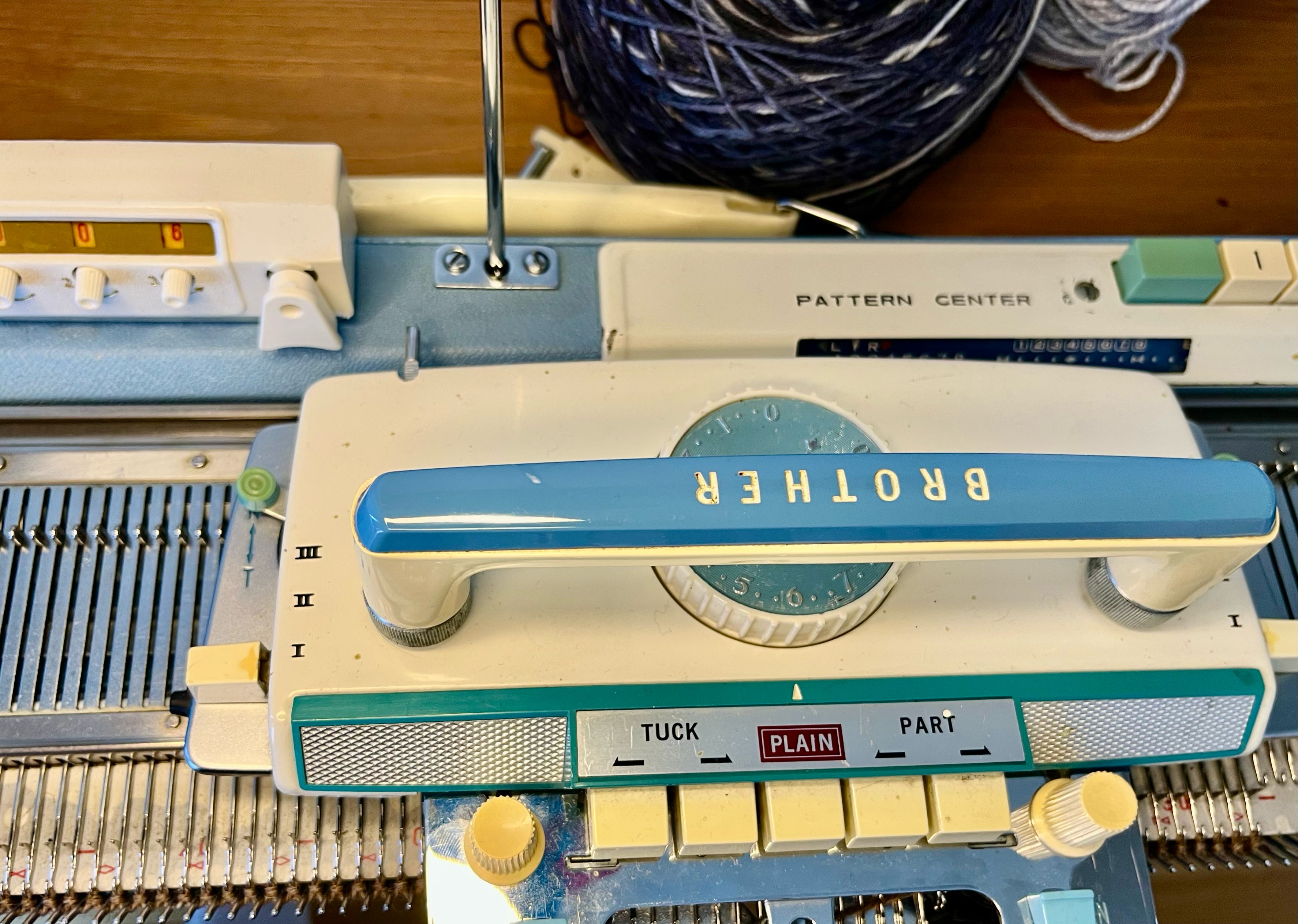
I’ve been hand-knitting for a number of years, and now that I’m comfortable with most techniques, I often find myself with plenty of creative ideas and not enough time to test them. A few weeks ago, a vintage Brother KH585 from the mid-sixties appeared on a local second-hand platform at a price I couldn’t justify refusing. I thought, “This is perfect, finally I can test all of my knitting ideas quickly and easily, without spending hours knitting swatches by hand. It’s the same craft, just quicker”.
While that assumption turned out to be incorrect, I don’t feel misled or disappointed, but rather surprised. I expected to extend a craft I already had, and instead I seem to have started a different one.
The first thing that surprised me was how mechanical it felt. I’m not a very handy person. I don’t have a feel for engines or an instinct for how things fit together physically, despite being a scientist. Opening up a sixty-year-old knitting machine and discovering, from an old manual, that I needed to oil the needle butts was not something I felt prepared for. There’s a whole vocabulary of levers and cams and carriages that has nothing to do with knowing how to knit, and learning it felt less like picking up a new technique and more like becoming, reluctantly, a small-scale mechanic.
I pushed through mostly because I had nothing to lose. The machine was cheap, my frustration was real, and stubbornness is a reasonable substitute for confidence.
The KH585 dates from the mid-sixties, and the core mechanism runs without complaint. Sixty years is a long time for any piece of equipment to remain functional, let alone precise enough to use for serious work. It suggests that the people who designed and built these machines were thinking about longevity in a way that feels uncommon now. A phone bought today will likely be replaced before it breaks. A machine tool from 1965 is still doing what it was built for.
The machine has its own parameters, its own logic, its own constraints. Gauge behaves differently, and swatching becomes non-negotiable. Certain things that are trivial by hand become genuinely convoluted on the machine, and vice versa. Tuck stitches, for example, are remarkably easy on a machine, while doing them by hand can feel like a real slog. On the other hand, knit-purl textures and especially cables, are not automated on most domestic knitting machines. Garter stitch, which is usually the first fabric we learn to create as hand knitters, is not a stitch for beginners on the machine. Something meditative by hand becomes fiddly and prone to dropped stitches.
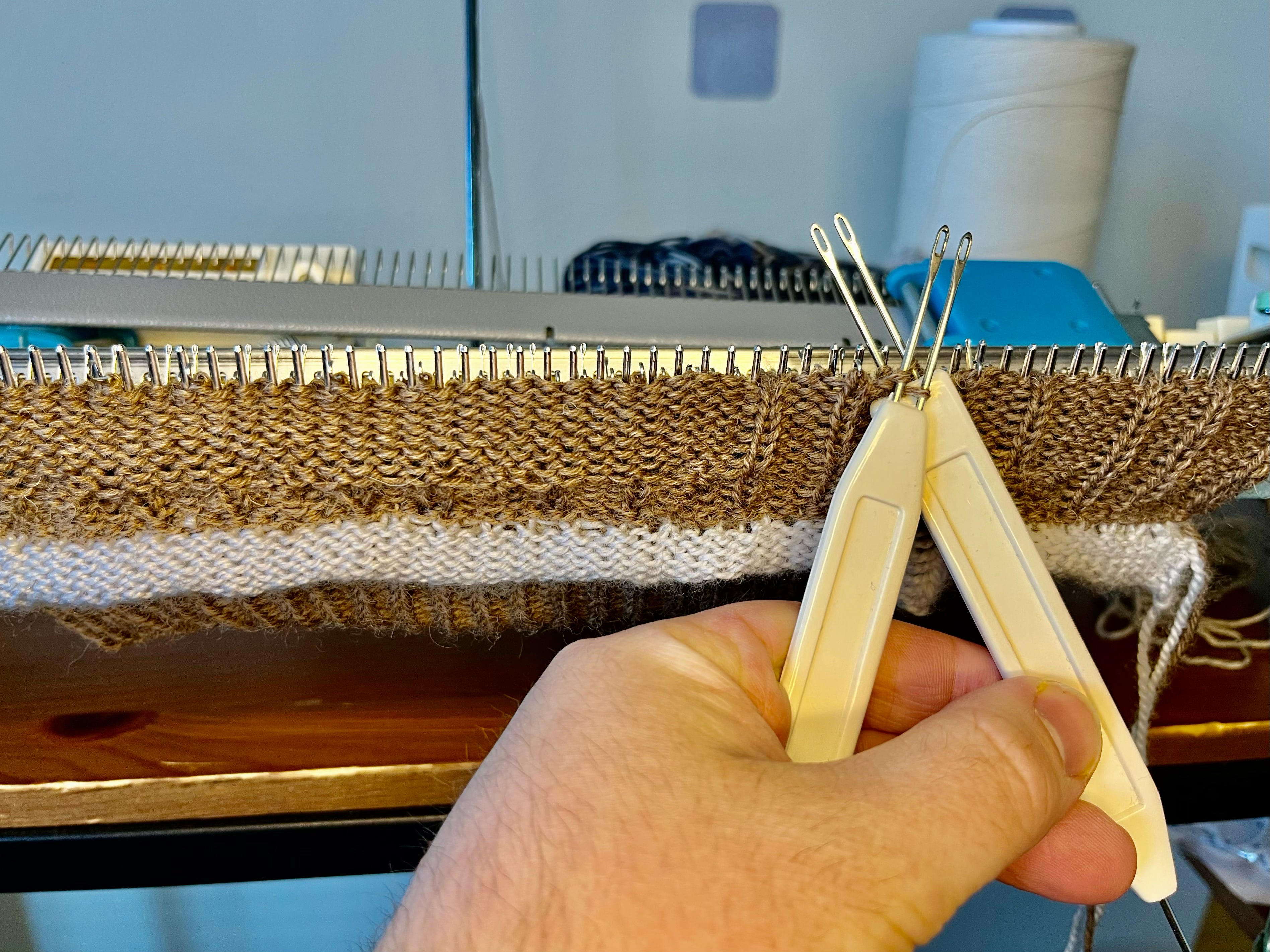
Cables have been known as “the great equaliser” of knitting machines: no matter how fancy your machine is, you make cables by transferring stitches individually using a transfer tool. It is (relatively) slow, precise work.
I have started to see hand knitting and machine knitting as two separate crafts, that share a common structure. The basic mechanics of both involve a loop pulled through a loop, and they can produce the same kinds of fabric with the same sensibilities, but they ask very different things of the crafter. Rather than one being a faster version of the other, they feel more like siblings. Related, recognisably from the same family, but with their own distinct characters. Modern hand knitters tend to see knitted fabric stitch by stitch, and enjoy great freedom in being able to try garments on intermittently while they’re being made. When you’re machine knitting, you often think in entire rows rather than stitches, and you are inherently limited by the gauge and number of needles on your machine. In my experience over the past few weeks, the actual knitting time on the machine is short, but the planning and finishing can be a much lengthier and less avoidable part than I’m used to.
* * *
I’ve often seen hand-knitters act dismissive of machine knitting in a way that doesn’t really hold up historically. The knitting frame was invented in 1589 by a Nottinghamshire clergyman named William Lee. Elizabeth I refused to grant him a patent, reportedly on the grounds that the machine would deprive hand-knitters of their livelihoods. Eventually, the hand-knitting economy did decline, but in its place sprang entire regional economies based on the knitting frame. By the early nineteenth century, there was a large class of skilled framework knitters whose wages and working conditions depended entirely on how those machines were used.
Those machines produced fully fashioned hosiery: stockings and other garments knitted directly to shape on narrow frames, seamless, made in one piece. It was skilled work, regulated by trade agreements, and the quality of the fabric was the basis of the whole industry. What changed in the early nineteenth century was that manufacturers began using wide frames to produce cut-up goods instead. Wide frames produced a flat fabric that was then cut and sewn into shape. The seams showed. The items wore out faster. Wide frames could also be operated by cheaper, untrained workers.
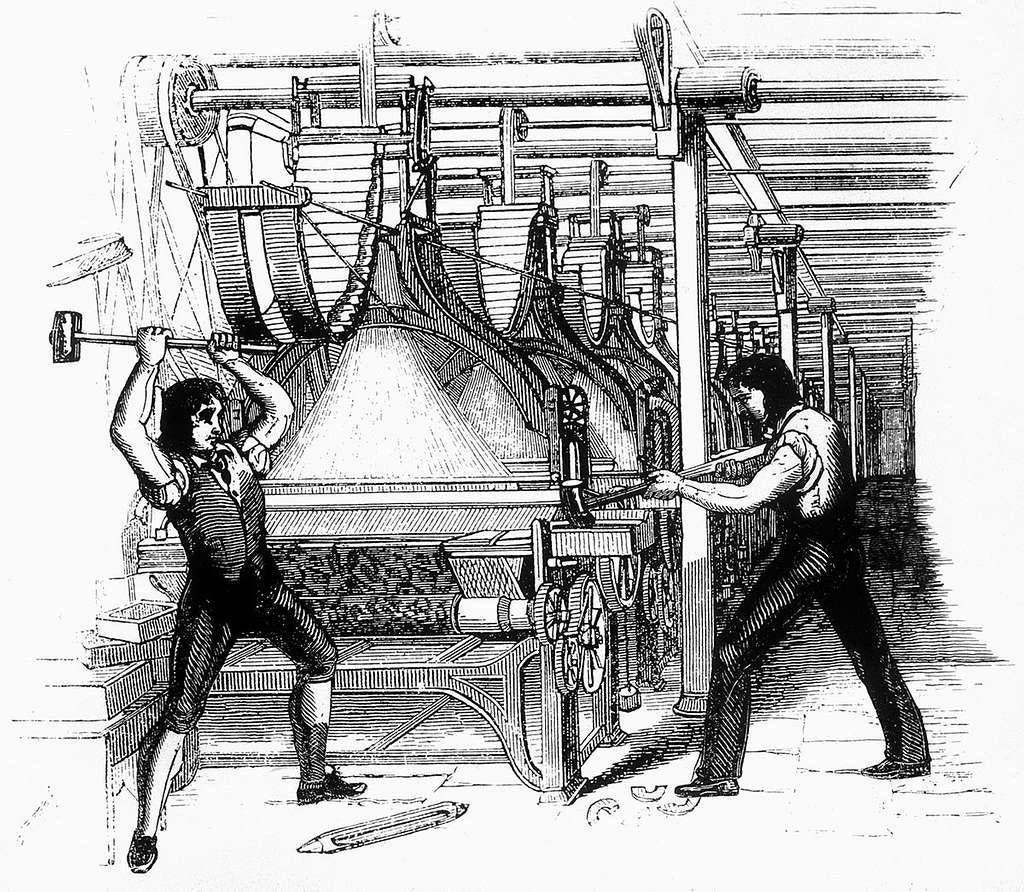
The Luddites existed in this context. Their name now gets used casually to mean anyone suspicious of emerging technology, which erases what was actually happening: skilled workers in Nottinghamshire, Yorkshire, and Lancashire watching manufacturers use wide-frame machinery to produce inferior goods and bypass apprenticeship rules. The machines weren’t new, and the workers knew how to use them. What they were disputing was what the machines were being used to produce, and who got to decide. They had petitioned Parliament for statutory protection and been refused. When they started smashing frames, they were selective about it: the targets were specific hosiers known to be using wide frames or paying below-agreed wages, not machinery in general.
The government’s response was to make frame-breaking an offence punishable by death. Lord Byron spoke against the bill in the House of Lords in 1812, arguing that the government was prepared to hang starving men over a trade dispute, and asking whether their lives were worth less than the frames they had broken.
Knitting has been tangled up with questions of industry, labour, and technological change for as long as anyone has tried to do it at scale. The handmade and the mechanical have never really been opposites; they have been intertwined for four hundred years.
The urge to legitimise craft nowadays is worth sitting with, because it’s largely shaped by how we think about time. Under the logic most of us have absorbed, leisure needs justification: it was earned, or it produced something, or it demonstrates something about you. Hand-knitting a sweater costs far more time than buying one. What it buys instead is a demonstration of patience, skill, and a certain freedom from efficiency. That’s not a criticism. It’s just worth naming: the insistence on handmade is at least partly a way of showing what your time is worth, or what you can afford to do with it.
The machine sits awkwardly here because it looks like a concession to efficiency, and efficiency, in this framing, is the enemy. But the claim that machine knitting isn’t “really” handmade starts to collapse under any pressure. The five-euro t-shirt we can buy at the click of a button may not feel handmade, but it was sewn by a person operating a sewing machine. The fabric was woven on an industrial loom by someone, somewhere. Fully automated textile production is mostly a fiction; there are human hands in all of it. What we’re actually debating isn’t whether hands were involved (they always are) but which hands, doing what, for how long, and whether that counts as craft or merely labour.
When I bought the machine, I expected to knit faster. Instead, it feels like I’ve gained a second craft, related to the first but distinct from it, with its own history I’m only beginning to investigate, and its own aesthetic possibilities I haven’t fully worked out yet. That’s a lot more than I was shopping for.
* * *
This is the beginning of a longer look at both crafts: machine knitting and hand knitting, their shared history, the communities keeping them going, and what each produces when you push it. More on all of that soon. If you work with either or have been thinking about starting, I’d be glad to hear about it in the comments.
Further reading
Crich Parish: framewreckers, a local account from Derbyshire, near the centre of the dispute.
Kevin Binfield on the Luddites, from the editor of Writings of the Luddites (2004).
Unmaking as Emancipation (CHI 2023), on Luddism, selective refusal, and social justice.
This Substack is reader-supported. To receive new posts and support my work, consider becoming a free or paid subscriber.
💯 Excellent. I love this! Also, sorry if a duplicate comment displays as I started one comment, and then it suddenly disappeared, but 'Engineering Knits', on youtube also has a show or two where the presenter works on a knitting machine, so if you have never seen a knitting machine in action, try 'Engineering Knits' on youtube.
Have you been to Shetland? Almost all the gorgeous “hand knit” sweaters are knit on knitting machines and then hand finished.