

What a 13th-Century Knitting Mistake Reveals About Medieval Technique
One wrong stitch in a 13th-century Votic mitten, and why it tells us more than all the correct ones

Most of what a historical knitter knew disappears along with them. You can examine a surviving piece of fabric and determine the fibre, the gauge, the spinning direction of the yarn, sometimes the structure of a colour pattern. But technique, the way the knitter held their hands, how they tensioned the yarn, which direction they moved through the stitches, leaves no trace in the finished object. This is one of the things that makes writing the history of knitting quite difficult: the evidence that would tell us the most about how people actually knitted is the evidence that disappears first.
A fragment held in the Estonian Institute of History is one of the rare exceptions.
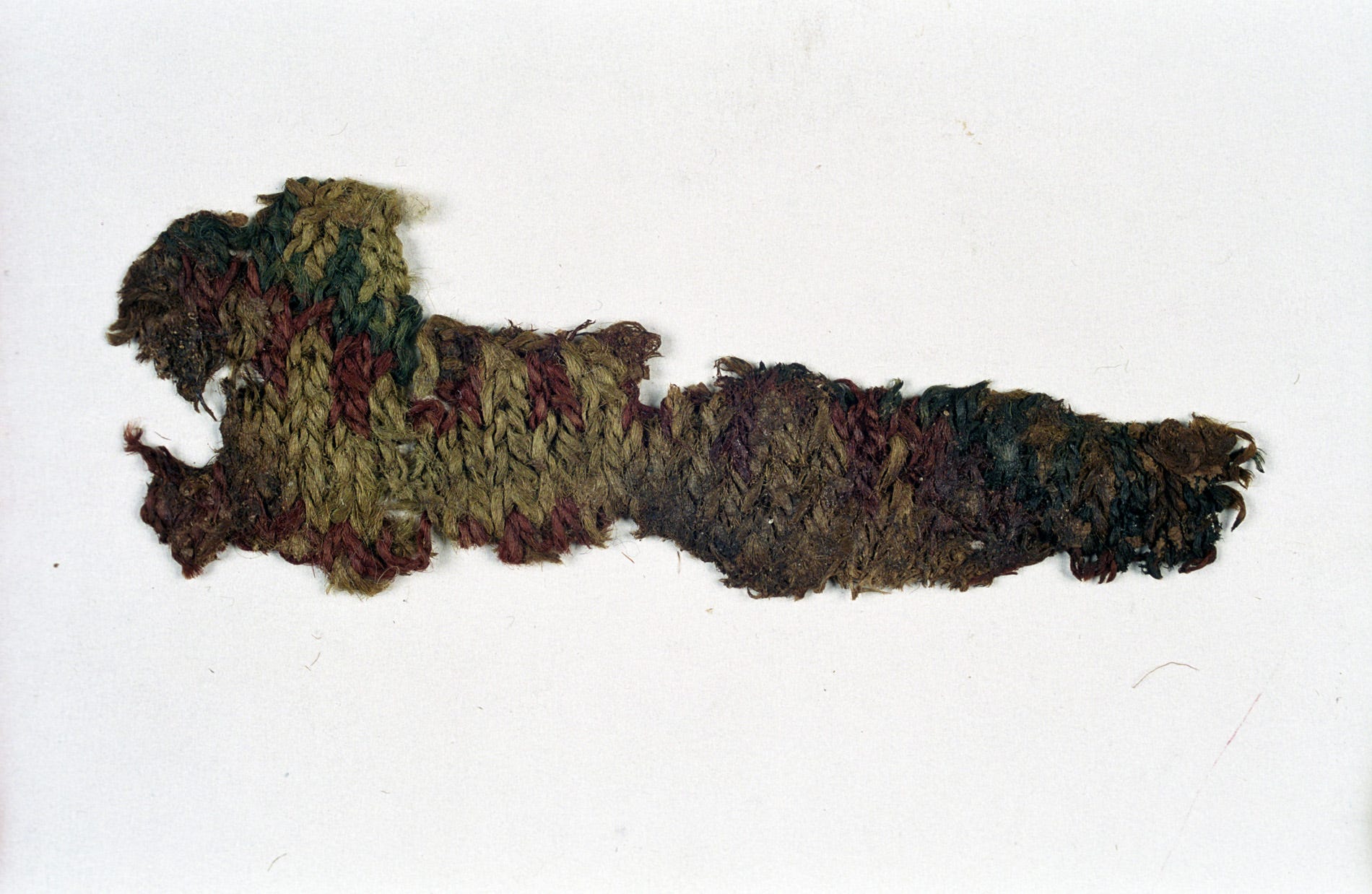
The fragment was excavated in 1949 from a Votic cemetery at Jõuga in North-Eastern Estonia. It is likely a part of a mitten cuff, since it was found at the hand of a woman in her grave. The burial has been dated to 1238–1299, making the mitten at least 700 years old and possibly closer to 800. It sat in the collection for most of the twentieth century, mentioned in passing in a 1993 article about textiles from Votic cemeteries, but the knitting technique went unexamined until researcher Anneke Lyffland published a close study in 2005.
The Votics were a Finnic ethnic group who lived along the northern shores of Lake Peipus, west of modern-day St. Petersburg. The fragment gives some sense of what this mitten was: relatively fine gauge (25 sts × 30 rows per 4” / 10 cm), worked in stranded colourwork using red, blue, and natural white. The red was dyed with madder; the blue with indigo, which had to be imported at considerable cost and was blended with undyed fibre to stretch it further. In Estonian folk belief, red was associated with blood and had protective properties; it was thought that evil and disease could not cross a boundary of red. All of this points to the mitten almost certainly being made for a wedding or a funeral, and the knitting throughout is consistently even, with the floats well managed. This was clearly not the work of a beginner.
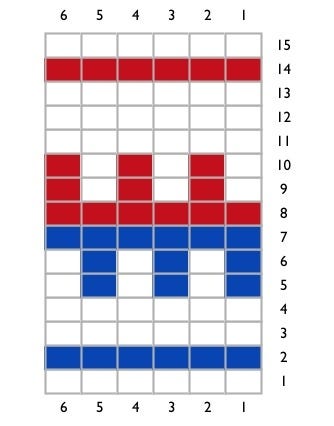
What Lyffland found, working carefully through the stitches to correct an earlier account that had mis-described the stitch pattern, was a single crossed stitch in the solid red row. Every other identifiable stitch in the fragment is uncrossed. In knitting, a crossed stitch is one where the legs of the loop sit twisted against each other, the result of entering a stitch from the wrong side. It can be done deliberately for texture, but here, in an otherwise uncrossed piece, it is likely a mistake. The knitter slipped up once, in what was probably a row worked by firelight or candlelight, and moved on.
That mistake is the reason we know anything at all about their technique.
The two main methods of hand knitting, what we call Eastern and Western, produce identical fabric when worked correctly. A piece of stockinette made by an Eastern knitter looks exactly like one made by a Western knitter. This means that for the vast majority of surviving historical knitting, including some of the most celebrated pieces that have come down to us, there is simply no way to determine how the knitter held their yarn or wrapped their needle.
The difference between the methods lies in how stitches sit on the needle before they are worked. Eastern knitters, looping the yarn from back to front around the needle, end up with stitches oriented differently from Western knitters. Both compensate automatically as they work, entering each stitch from the appropriate side and producing an uncrossed result. But when a stitch gets worked from the wrong side by mistake, the resulting cross slants in a direction determined by the method: right-slanting for an Eastern knitter, left-slanting for a Western one.
The crossed stitch in this fragment slants to the right. Lyffland also observed that Eastern knitting tends to untwist s-spun yarn, and this effect is visible in close-up photographs of the stitches, which corroborates the conclusion. The knitter was using the Eastern method, but we can’t know whether they held their yarn in the left or right hand. According to Anu Pink, the current authority on traditional Estonian knitting, knitters predominantly knitted “English” style up until influence from Finnish craft teachers led to a switch to continental knitting.
Most of the time, when we make a mistake in our knitting, the question is whether to fix it. It is easy to feel the work is somehow compromised, or that we failed ourselves (or the recipient) by not paying close enough attention. This knitter was clearly paying attention; the rest of the fragment is meticulous. The single wrong stitch probably went unnoticed by them, and everyone around them.
The correct stitches, thousands of them, consistent and even throughout, ironically tell us very little about the hand that made them. The one that went wrong, eight centuries later, tells us quite a lot. Perhaps the mistakes we make now could be just as valuable to someone else in the future.
Further reading
Anneke Lyffland, “A Study of a 13th-Century Votic Knit Fragment” (2005). The primary source for everything in this essay. Lyffland examined the fragment held at the Estonian Institute of History (AI 4008 XXII: 156).
Anu Pink “Knitting style – the grace of noble ladies or the speed of peasant girls?”, Studia Vernacula, vol. 11 (2019). The current authority on traditional Estonian knitting, covering regional styles, techniques, and the historical shift from English to Continental method.
I’ve heard of cultures that leave a small mistake in their work on purpose -have you ever heard of this? It would be interesting if that was the case and they found the fragment that had the mistake!
That’s fascinating. Funny to think it’s our mistakes that tell our stories. I like that.